How to teach Artificial Intelligence to children with a story
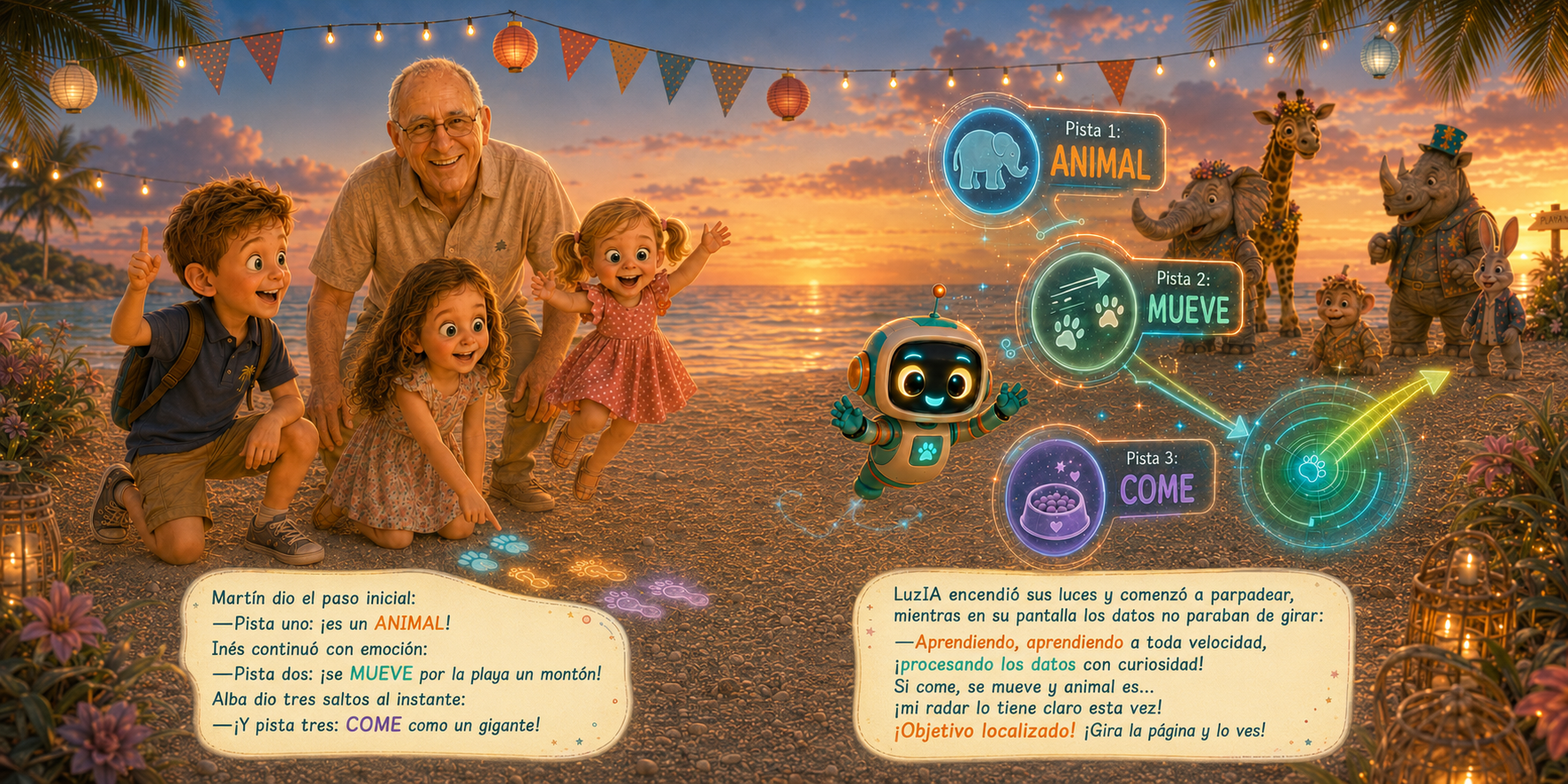
Artificial Intelligence is increasingly part of children's daily lives, but explaining how it works without overwhelming them is a challenge for many families and educators. LuzIA in search of my companion dogs turns that challenge into an adventure: instead of talking about algorithms and models, the story teaches the fundamentals of machine learning through clues, observation and trial-and-error.
In the story, the robot LuzIA doesn't know what a dog is. To find Pluto, Bimba and Mía, children give her clues: "it's an animal", "it moves", "it eats a lot". Each clue helps LuzIA compare what she sees with what she knows, ruling out wrong options (like a parrot that flies) and improving with each attempt. This way, without technical jargon, readers understand the machine learning cycle: observe, compare, try, make mistakes and improve.
This narrative approach is especially effective in early childhood because it translates abstract concepts into emotions and concrete situations. When a child sees LuzIA confuse a parrot with a dog, they don't just laugh: they also understand that making mistakes is a natural part of learning. The pedagogical message is clear: mistakes are not failures, but opportunities to adjust and improve, exactly as real AI systems are trained.
In addition to technical concepts, the story works on cross-cutting values such as curiosity, perseverance, teamwork and empathy. The three siblings show that by listening to each other and collaborating, they go further; and Grandpa José represents the role of adult guidance in learning. The story also shows that technology, far from being cold or distant, can be a companion that needs human help to learn.
For families, reading this story opens the door to conversations about technology without fear: asking "how do you think LuzIA learns?" or "what does she get wrong?" invites children to think critically. For educators, the book is an ideal starting point for units on AI, computational thinking or emotional education, with downloadable resources and hands-on activities available on this very website.

